Water treatment
Best reverse osmosis systems under $400
Updated Editor: Diego Ruiz
Kept & Sound earns a commission when you buy through links on this page. Commission does not change the order we rank products in.
Five of the six reverse osmosis systems on this page are under-sink tank systems with price bands under $400, and the sixth is a tankless stretch pick. We ranked all six on their spec sheets and a review-analysis tool run over verified buyer reviews.
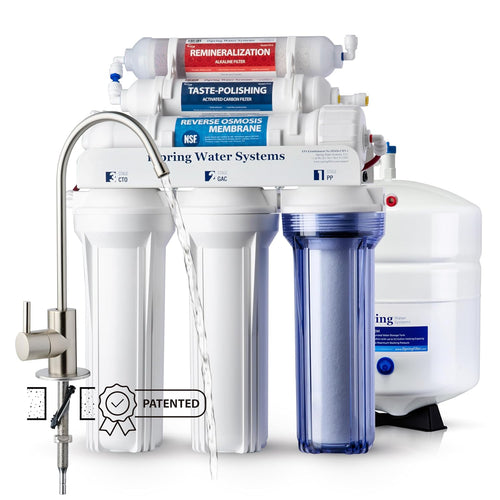
Best overall
iSpring RCC7AK-BN
iSpring
Best for: Families who want a tank RO with remineralized taste
- Easy to install
- Clear instructions
- Watch for: Faucet leaks at the base or spout
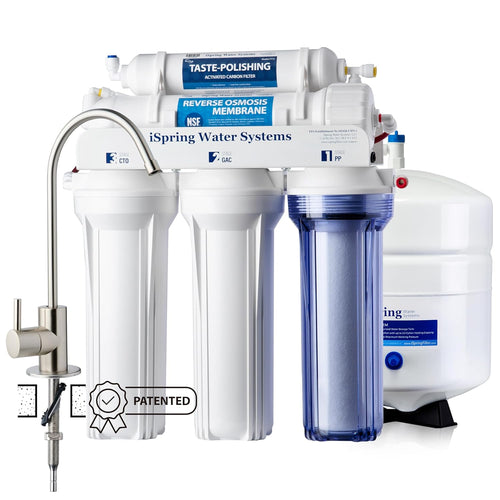
Runner-up, no remineralization
iSpring RCC7-BN
iSpring
Best for: Buyers who want a proven 5-stage tank RO without add-ons
- Easy to install
- Clear instructions
- Watch for: Faucet leaks
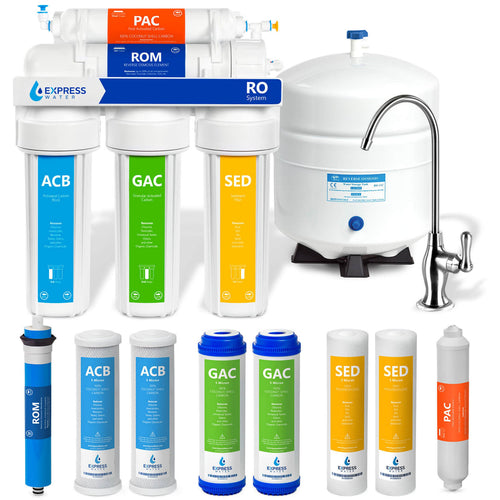
Budget pick
Express Water RO5DX
Express Water
Best for: Buyers who want certified tank RO at the lowest price band here
- Easy to install
- Good build quality
- Watch for: Leaks at fittings for some
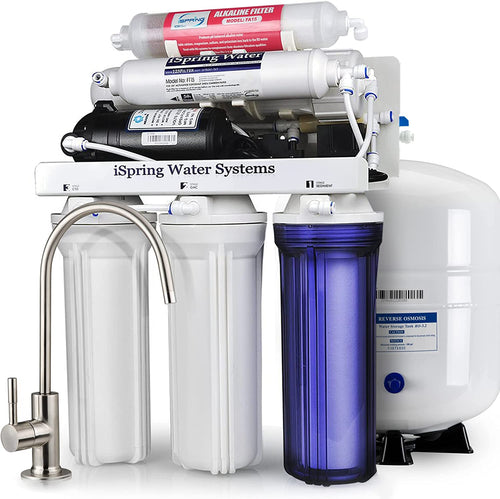
Best for low water pressure
iSpring RCC7P-AK
iSpring
Best for: Low-pressure homes that need a booster pump
- Easy to install
- Solid unit
- Watch for: Some leaks during setup
Long record, most leak reports
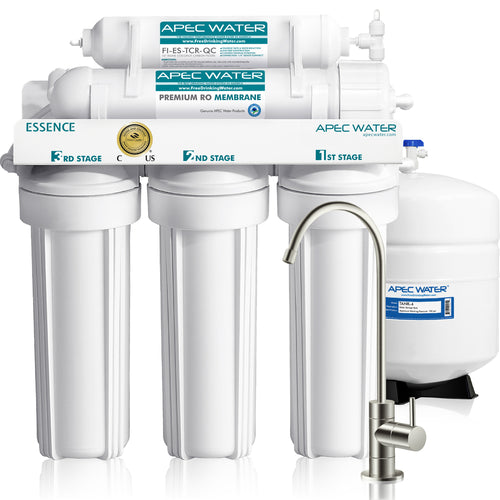
APEC ROES-50
APEC Water
Best for: Basic five-stage RO for buyers who will check every fitting
- Easy to install
- Filters well
- Watch for: Leaks, the largest complaint theme
Tankless stretch pick over $400
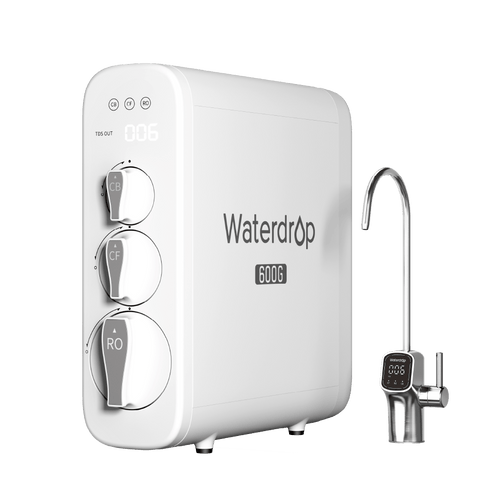
Waterdrop G3P600
Waterdrop
Best for: Small cabinets where a storage tank will not fit
- Easy to install
- Good water and filters
- Watch for: Leaks at fittings or underside
Side by side
| Spec | iSpring RCC7AK-BN | iSpring RCC7-BN | Express Water RO5DX | iSpring RCC7P-AK | APEC ROES-50 | Waterdrop G3P600 |
|---|---|---|---|---|---|---|
| Stages | 6, with alkaline remineralization | 5 | 5 | 6, with alkaline remineralization | 5: sediment, two carbon blocks, membrane, carbon | 8 |
| Output | 75 gal/day | 75 gal/day | 50 gal/day | 75 gal/day | 50 gal/day | 600 gal/day |
| Design | Tank-based, top-mounted faucet | Tank-based, top-mounted faucet | Tank-based, chrome faucet | Tank-based, with booster pump | Tank-based, runs on line pressure | Tankless, under sink |
| Certification | NSF/ANSI 58 | NSF/ANSI 58 | NSF/ANSI 58 and 372 | Not listed | NSF/ANSI 58 and 372 | Not listed |
| Filter life | Pre-filters 6 to 12 months, membrane 2 to 3 years | Pre-filters 6 to 12 months, membrane 2 to 3 years | Not listed | Pre-filters 6 to 12 months, membrane 2 to 3 years | Pre-filters 6 to 12 months, membrane 2 to 3 years | RO membrane up to 24 months |
| Remineralization | Not listed | None | None | Not listed | None | Not included (add-on filter) |
| Leak detection | Not listed | Not listed | Included, per listing | Not listed | Not listed | Not listed |
| Pure to drain | Not listed | Not listed | Not listed | Up to 2:1 | Not listed | 2:1 |
How we ranked them
The review tool groups reviews by topic and counts how many reviews raise each one. We call those counts mentions. Where a model has few mentions, we say so.
We weighed output, certification, remineralization and price band against those review themes and the size of each review record. Some links on this page are Levanta partner links and others are Amazon Associates links, and neither kind changes the order.
The RCC7AK-BN and the RCC7-BN are variations on one listing. Their reviews are pooled across both, and that shared pool is the largest record on this page. The pool cannot tell you which version a buyer installed, so we split the two on specs.
iSpring RCC7AK-BN: best overall
It takes the standard five-stage layout and adds an alkaline stage that puts minerals back after the membrane, with NSF/ANSI 58 certification and a 75 gallon per day rating. It ranks first because it is the only pick here with the top tank output, remineralization and a listed NSF/ANSI 58 certification, in a $190 to $240 price band.
Buyers in the shared pool often praise the install. They describe it as easy, with clear instructions and filter changes that take little effort. Good water quality and value come up often too.
Two of the five main complaint themes are leaks. The faucet can leak at the base or the spout, and some fittings start dripping after setup. A few buyers say the install took hours, and a few saw filters clog early.
Skip it if you rent and cannot drill into the drain pipe.
iSpring RCC7-BN: runner-up
This is the same 75 GPD tank design with five stages and no remineralization, and it also carries NSF/ANSI 58. It ranks second because it matches the top pick on output and certification in a slightly lower $180 to $220 band.
Praise again centers on the install and the instructions, plus good filtration and a fair price. Owners also call it easy to maintain.
Buyers report faucet leaks, leaks at the manifold or a filter housing, and housings that are hard to unscrew at change time. Some find the instructions poor, even though others praise them.
Skip it if you already dislike the taste of mineral-free water.
Express Water RO5DX: budget pick
It is a five-stage tank system rated at 50 gallons per day, with NSF/ANSI 58 and 372 listed and the lowest price band here, $150 to $210. It ranks third because it costs the least and has a long review record, but it makes a third less water than the RCC7 models and adds no minerals back.
Its themes rest on a thin sample, about 37 praise mentions and 19 complaint mentions. Buyers praise an easy install, good build quality and simple filter changes. Some call it good value for an RO system.
Leaks at the fittings are the largest complaint theme, followed by hard installs and poor instructions. Some buyers had a cracked filter housing, and some criticize the drain saddle and the flood stop. One buyer received a used unit. Retailer listings disagree on the pre-filter schedule, 6 months on some and 12 on others.
Skip it if you want minerals added back to the water.
iSpring RCC7P-AK: best for low water pressure
It is the six-stage alkaline layout with a booster pump added, still rated at 75 gallons per day, and iSpring lists a pure-to-drain ratio of up to 2:1. It ranks fourth because the pump only pays off in homes with low water pressure, and the specs we have list no certification.
Buyers rate it highest of the six, but the themes come from about 52 praise mentions and 20 complaint mentions, a thin sample. Buyers praise the install, the solid build and better flow from the pump. Some say theirs has lasted for years.
Some buyers had leaks during setup and slow installs. A few had filters that did not fit their housings, and a cracked filter and a rattling noise each came up.
Skip it if your water pressure is already normal, since the pump adds cost and one more part to fail.
APEC ROES-50: long record, most leak reports
It is a five-stage tank system rated at 50 gallons per day with NSF/ANSI 58 and 372 listed, a $170 to $240 price band and the second largest review record here. It ranks fifth because its review analysis holds nearly three complaint mentions for every praise mention, and leaks make up the largest share.
About 42 praise mentions cover an easy install, good filtration and water quality, a fair price and clear instructions.
The 117 complaint mentions are harder to ignore. Leaks account for 51 of them, and some buyers say a leak caused water damage. Other complaint themes are filters that crack or do not fit, units that break down after a few years and repairs that need a new housing.
Skip it if you cannot check under the sink for drips in the first weeks.
Waterdrop G3P600: tankless stretch pick
It makes water on demand with no tank, rated at 600 gallons per day, with eight stages and a listed 2:1 pure-to-drain ratio. Its $420 to $540 band sits above this page's ceiling, so it ranks last as a stretch pick for cabinets where a tank will not fit.
Its review record is longer than that of the iSpring RO500AK, the other tankless model we cover. Buyers praise the easy install, easy filter changes, good water and the space the tankless design saves, and some call it worth the price.
Complaints include leaks at fittings or underneath, pump noise, a TDS readout that drifts and units that fail within months. Some buyers also report filter housing problems. Its base listing adds no minerals back, and the remineralization filter is a separate add-on.
Skip it if your budget stops at $400.
If you want tankless with minerals added back, the iSpring RO500AK is rated at 500 gallons per day in a $560 to $630 band. We put it against our top pick in iSpring RCC7AK vs RO500AK.
What to check first
Stages come first. A five-stage system usually means sediment and carbon pre-filters, the RO membrane and a final carbon filter. A sixth stage on two of these picks is for remineralization. More stages do not mean cleaner water once the membrane has done its job.
GPD is the next number. A 75 GPD rating works out to about 3 gallons an hour, and 50 GPD to about 2, both measured under test conditions. Real output drops with low water pressure and cold water. A tank system refills between uses, so either rate keeps up with drinking and cooking in most homes.
Tank or tankless decides your cabinet space. A tank stores filtered water, so flow at the faucet slows as the tank empties. A tankless unit makes water on demand and costs more.
Remineralization is about taste. The membrane strips out most dissolved minerals, and an alkaline stage adds some back. If you drink the water plain, it is worth the small step up.
Certification tells you what was tested. NSF/ANSI 58 is the standard for reverse osmosis drinking water systems. NSF/ANSI 372 covers lead content in the parts that touch your water.
The drain ratio tells you how much water goes down the drain. A 2:1 ratio means one gallon to drain for every two you drink. Only the RCC7P-AK and the G3P600 list one here.
Yearly filter cost is easy to miss. Price one set of pre-filters and one membrane up front, and count two pre-filter changes a year if your water carries sediment.
Installation is a do-it-yourself job for many buyers, though some report it took hours. Plan for drilling the drain pipe, and for a faucet hole if your sink has no spare. A booster pump also needs a power outlet.
Our verdict
Our pick: iSpring RCC7AK-BN.
Best for: Families who want a tank RO with remineralized taste.
See price on AmazonGet price drops by email
Price drops and new picks for water treatment, one email a month at most, reply stop to unsubscribe.
Questions people ask
- Is 50 GPD enough for a family of four?
- For drinking and cooking, usually yes. 50 gallons per day works out to about 2 gallons an hour, and the tank holds a reserve between uses. If you fill a lot of pots and pitchers, the RCC7 models are rated at 75 GPD.
- How often do I change the filters on an RO system?
- iSpring lists 6 to 12 months for the pre-filters and 2 to 3 years for the membrane on its three picks, and retailer pages give the ROES-50 a similar schedule. Listings for the RO5DX disagree, so check its manual. Slower flow at the faucet is the usual sign a change is due.
- Do I need a plumber to install an under-sink RO system?
- Many buyers do it themselves, and easy installation is a common praise for every pick here. You will need to drill a hole in the drain pipe for the drain saddle, plus a spare sink hole or a drilled one for the faucet. Leaks at fittings show up in the complaints for every pick, so check each joint the next day.
- What is the difference between the RCC7AK-BN and the RCC7-BN?
- The RCC7AK-BN adds a sixth stage that puts minerals back into the water. Both are tank systems rated at 75 gallons per day with NSF/ANSI 58 certification. Their reviews are pooled on one listing, so buyer feedback does not separate them.
How we researched this
This roundup rests on manufacturer specs, certification listings and a tool-based analysis of verified buyer reviews. The analysis groups reviews by topic and counts how many raise each one, for praise and for complaints. We did not buy or test any of these units. Our rankings reflect what that evidence says, not hands-on trials.