Water treatment
iSpring RCC7AK vs RO500AK: tank or tankless
Updated Editor: Diego Ruiz
Kept & Sound earns a commission when you buy through links on this page. Commission does not change the order we rank products in.
A tank RO and a tankless RO do the same job at very different prices. The iSpring RCC7AK-BN stores water in a tank at 75 gallons per day, and the RO500AK makes 500 gallons per day on demand from a price band more than twice as high.
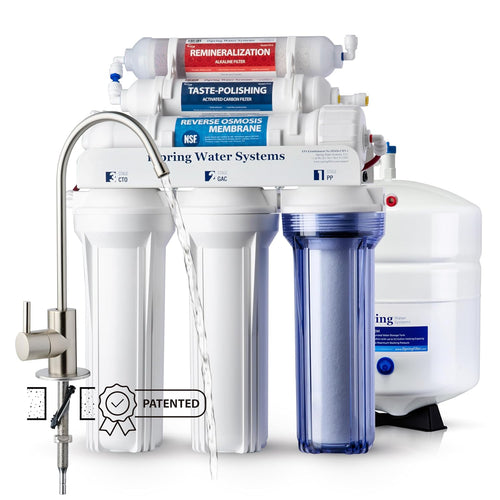
Our pick, tank system
iSpring RCC7AK-BN
iSpring
Best for: Families who want a tank RO with remineralized taste
- Easy to install
- Clear instructions
- Watch for: Faucet leaks at the base or spout
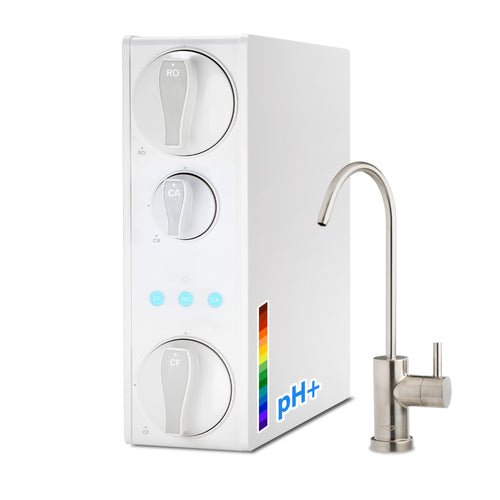
Tankless alternative
iSpring RO500AK
iSpring
Best for: Households that want tankless output and a quiet pump
- Easy to install
- Quiet for a tankless
- Watch for: Costs more than tank systems
Side by side
| Spec | iSpring RCC7AK-BN | iSpring RO500AK |
|---|---|---|
| Stages | 6, with alkaline remineralization | Not listed |
| Output | 75 gal/day | 500 gal/day |
| Design | Tank-based, top-mounted faucet | Tankless, under sink |
| Certification | NSF/ANSI 58 | NSF/ANSI 58 |
| Filter life | Pre-filters 6 to 12 months, membrane 2 to 3 years | Not listed |
| Pure to drain | Not listed | Up to 2:1 |
| Remineralization | Not listed | Yes, alkaline stage |
| Power | Not listed | Needs an electrical outlet |
The short answer
Buy the RCC7AK-BN if you want the lower cost and the much larger review record. It covers drinking and cooking water for most households.
Buy the RO500AK if cabinet space is tight, you fill big pots often, or you are tired of waiting for a tank to refill. You also need an outlet under the sink for it.
We compared the two on spec sheets and a review-analysis tool run over verified buyer reviews. The tool groups reviews by topic and counts how many reviews raise each one, which we call mentions.
Output: 75 versus 500 gallons per day
75 GPD works out to about 3 gallons an hour. The RCC7AK-BN makes water slowly and stores it in the tank, so a glass comes out fast while the tank is full. Flow at the faucet tapers as the tank empties, and refilling it takes time.
500 GPD is about 21 gallons an hour, or roughly a third of a gallon a minute. The RO500AK makes that water as you open the faucet, so there is no stored reserve to run out of. Both ratings are measured under test conditions. Low pressure and cold water lower real output on any RO system.
Living with each one
A tank system has a reserve, and the reserve can run out. Filling a stock pot, a coffee maker and a few water bottles in one go can drain it. After that you wait for a slow refill at about 3 gallons an hour.
The RO500AK has no reserve to drain, so back-to-back fills are not a problem. The catch is power. If the outlet loses power, the pump stops, and so does your filtered water until it comes back.
Noise matters more under some sinks than others. RO500AK buyers call it quiet for a tankless unit. The RCC7AK-BN has no pump in its spec, so there is no motor to hear.
Drain ratio and water use
Every RO system sends part of its feed water down the drain to keep the membrane clean. iSpring lists a pure-to-drain ratio of up to 2:1 for the RO500AK. That is one gallon to drain for every two gallons you keep.
We have no drain ratio for the RCC7AK-BN and will not guess one. If water use is your main concern, ask iSpring for the figure.
Footprint and power
The RCC7AK-BN needs room for a storage tank next to the filter housings. The RO500AK has no tank, which frees up cabinet space for the trash can or cleaning supplies.
Power is the trade. The RO500AK needs an electrical outlet under the sink. The RCC7AK-BN lists no pump and runs on line pressure, so it works where there is no outlet at all.
Filters
The RCC7AK-BN has a clear schedule. iSpring lists pre-filter changes every 6 to 12 months and a new membrane every 2 to 3 years.
The RO500AK specs we checked list neither filter life nor stage layout. Its buyers do flag cost: pricey replacement filters are one of its five main complaint themes, and some found the filter instructions unclear. Price a full replacement set for both systems, then divide by the change interval.
Remineralization and certification
Here the two match. Each has an alkaline stage that puts minerals back after the membrane, and each carries NSF/ANSI 58 certification.
Where the RCC7AK-BN wins
Price and track record. Its listing shares one review pool with the five-stage RCC7-BN, a far larger record than the RO500AK's. Owners praise the easy install, the clear instructions and how simple filter changes are, and many call it worth the price.
It also asks less of your kitchen. It needs no outlet, and its filter schedule is published.
Its weak spot is leaks. Two of its five main complaint themes are a faucet that leaks at the base or the spout and fittings that drip after setup. A few buyers spent hours on the install, a few had filters clog early, and the drain saddle needs a hole drilled in the drain pipe.
Where the RO500AK wins
Speed and space. It makes water on demand at 500 gallons per day and frees the cabinet floor a tank would take.
Buyers rate it level with the RCC7AK-BN, but its themes come from a thin sample, about 57 praise mentions and 17 complaint mentions. Read them as early signals. Buyers praise the install, say it runs quietly for a tankless unit and mention few leaks, which stands out next to the tank model. They also like the filter changes and the solid build.
Its weak spot is cost. Complaints start with the price of the unit and of replacement filters. A few buyers had a filter come loose, and one owner reported random shutoffs.
Who should pass on each
Pass on the RCC7AK-BN if you have no room for a tank under the sink.
Pass on the RO500AK if you have no outlet under the sink or a firm $400 budget.
A cheaper tankless option
The Waterdrop G3P600 is also tankless, rated at 600 gallons per day in a $420 to $540 price band, below the RO500AK's. Its base listing has no remineralization stage. We rank it as the tankless stretch pick on our best reverse osmosis systems under $400 page.
Before you order either one
Open the cabinet and measure it. Note the width, the depth and where the drain pipe runs. A tank system needs floor space for the tank as well as the filters. A tankless unit is one box, but it needs an outlet within cord reach.
Check your water pressure. A cheap gauge on an outdoor spigot gives you a number in a minute. Low pressure slows any RO system and pushes more water to the drain. It hits a tank system harder, because the tank fills against its own back pressure.
Plan the faucet. Both systems use a dedicated drinking water faucet. If your sink has no spare hole, you will drill one in the sink or the countertop.
Plan the drain. The drain saddle clamps onto the drain pipe and needs a small hole drilled into it. RCC7AK-BN buyers raise this often enough that it should not surprise you.
Count the filter cost over three years, not one. On the RCC7AK-BN the membrane change lands in year two or three, and that is the year the cost spikes.
After the install, check every fitting the next morning. Leaks are where the tank model's complaints cluster.
If you are still choosing among tank systems, our best reverse osmosis systems under $400 page ranks the RCC7AK-BN against five other systems, including the five-stage RCC7-BN and the pump-equipped RCC7P-AK.
Our verdict
iSpring RCC7AK-BN is the one we would buy.
Best for: Families who want a tank RO with remineralized taste.
See price on AmazonGet price drops by email
Price drops and new picks for water treatment, one email a month at most, reply stop to unsubscribe.
Questions people ask
- Is a tankless RO system worth the extra cost?
- It is if you fill large pots often, run out of tank water, or have no room for a tank. For drinking water alone, the RCC7AK-BN's 75 gallons per day keeps up in most kitchens. The RO500AK's price band starts more than twice as high as the RCC7AK-BN's.
- Does the iSpring RO500AK need electricity?
- Yes. It needs an electrical outlet under the sink. The RCC7AK-BN has no pump and runs on your water line pressure.
- Which one wastes less water?
- iSpring lists a pure-to-drain ratio of up to 2:1 for the RO500AK, meaning one gallon to drain for every two you keep. We have no drain figure for the RCC7AK-BN. Ask iSpring or check the listing if that is your deciding factor.
- Do both systems remineralize the water?
- Yes. Each has an alkaline stage that adds minerals back after the membrane. Both also carry NSF/ANSI 58 certification for reverse osmosis systems.
How we researched this
This comparison rests on manufacturer specs, certification listings and a tool-based analysis of verified buyer reviews. The analysis groups reviews by topic and counts how many raise each one, for praise and for complaints. We did not buy or test any of these units. Our rankings reflect what that evidence says, not hands-on trials.